
Wait until high school to worry about imaginary numbers
It was a beautiful, sunny day on the playground and little Billy was excited. Today had been a good day. His class was learning how to add numbers. Billy was thrilled to finally begin to understand those symbols at the grocery store and count his Legos. He felt very grown-up, indeed. But when Billy returned back to the classroom from recess, his countenance had changed. He was quiet, even sullen as class resumed. As the teacher started explaining how to add three numbers together, he finally blurted out "I don't trust anything you're telling me. This math stuff is just a bunch of hogwash!" The teacher politely asked Billy if he had a question about what she was teaching. "I sure do-- lots of them! Were you just never planning on telling us these numbers that look so nice could turn evil and be negative? What kind of nonsense is that!" The teacher was taken aback and started to stammer out an answer, but before she got four words in, Billy steamrolled ahead with his tirade: "And then I heard you can take these numbers you've been showing us and then just carve them up into fractions and decimals? And then you shrink some of them down and make them exponents? And then you math people even come up with imaginary numbers and start using them with your real numbers and you think that's just okay? And then you start throwing letters in there and pretending they're numbers, too-- but secret numbers no one else is allowed to know? And where did a lot of this math come from? A guy named Archimedes. And he was a slave-owner who designed weapons for a tyrannical empire? How long were you going to keep that a secret, huh? Because if that's what math is, I'm not interested!" If you were the teacher, how would you handle that situation?

I'm running out of time
There's a line from the Pixar film "A Bug's Life" that sticks with me. It's the scene where you're first introduced to the circus performers who eventually become some of the story's heroes. The problem is, they stink, and their audience starts to leave mid-performance. One fly in particular indignantly stands up to leave, declaring, "I only got 24 hours to live, and I ain't gonna waste it here!" The 24-hour lifespan of a fly is a common myth—house flies actually live about a few weeks. But the mayfly does come close to that lifespan; once it grows out of its underwater nymph stage, it lives only a day or so—24 hours to fly, experience the world, mate, and quickly pass away. What would you do if you only had 24 hours to live?.

The paradox in the pause
Imagine you are young Nephi. Your father has just uprooted your family and led you all into the wilderness. Unlike your brothers, you turned to the Lord and received confirmation of your father's calling. Then the Lord revealed to you personally and directly that you and your brothers are headed for the land of promise. Immediately receiving this revelation, your father tells you "the Lord hath commanded me that thou and thy brethren shall return to Jerusalem" (1 Nephi 3:2). The verse ends there; I don't know if Lehi paused at this point in his discussion with Nephi, but I was prompted recently to pause there in my reading. If you were Nephi, what might you have thought and felt during that pause? "We're going back? But God just told me we're going to a new land! How can God contradict Himself?" Any paradox Nephi might have faced in that moment would have been fleeting as his father clarified the return would be temporary. But as I pondered on Nephi's "paradox in the pause," I remembered many other cases in scripture where Saints have had to face much tougher, much longer divine paradoxes-- some of which we still face today. And it's what we do with those paradoxes that demonstrates our faith.

Busting Myths about the Family Proclamation
Thirty years ago, in a meeting most of the world ignored, fourteen Apostles and a Prophet of God presented a proclamation. That proclamation would become one of the most quoted, debated, and misunderstood documents in modern religious history. When President Gordon B. Hinckley read "The Family: A Proclamation to the World" on Sept 23, 1995, few could have predicted the intense controversy and cultural battles that would hit us during the next 30 years, nor that this uncontroversial nine-paragraph statement would become the great divider of the Church. Yet the apostles who crafted it knew exactly what they were doing. And three decades later, their prophetic foresight has been vindicated. As the Church has made its stand, Satan has responded from both without and within the Church. One tactic he utilizes within the Church is to spread myths and misconceptions about the Proclamation itself, hoping to undermine its authority and the confidence of members in its teachings. Let's separate the truth from the myths.

Do We Proclaim the Proclamation?
I’ve always been an odd duck. Most kids played soccer during recess; I preferred reading and discussing theology. As a young adult, I discovered FAIR (a leading organization for Latter-day Saint scholarship and apologetics). Now, my annual pilgrimage to Utah for their conference is a highlight of my year. But Latter-day Saint apologetics is a niche hobby-- one my friends have always found uninteresting... until now. Over the past two weeks, many have reached out, saying they watched the FAIR presentations and want to attend next year’s conference. What sparked this newfound curiosity? The old adage: “There’s no such thing as bad publicity.”

You need to die
In Alma 22, we read of the powerful conversion of King Lamoni's father. I noticed something strange in the account following the king's lesson on the plan of salvation. The Book of Mormon is clear that the Nephites understood that both the wicked and the righteous would be resurrected. Yet, in response to learning about this universal resurrection, the king prays to God, asking "that [he] may be raised from the dead." Stranger still, in answer to this prayer, the king is immediately "struck as if he were dead." What is going on here? I have some thoughts.

You sure you want to say that?
A few years ago, I saw a Twitter post asking how a Latter-day Saint might respond to a situation involving family and same-sex marriage. It was a great question, so I reposted it with my brief thoughts about the tricky balance of love and faith and how I might respond, and then I happily went to bed. I had no idea what was about to happen.

Justice and Mercy Aren’t Enemies—They’re Married
I was standing in the Conference Center at Temple Square, a place I’d previously only seen on a TV screen. This past summer, I finally got to walk its halls in person—an experience that felt like stepping into a storybook. I’m not usually an art guy, but one painting in the Conference Center art gallery grabbed my attention immediately and hasn’t let go since.
More holiness give me... even if I'm not sure I want it
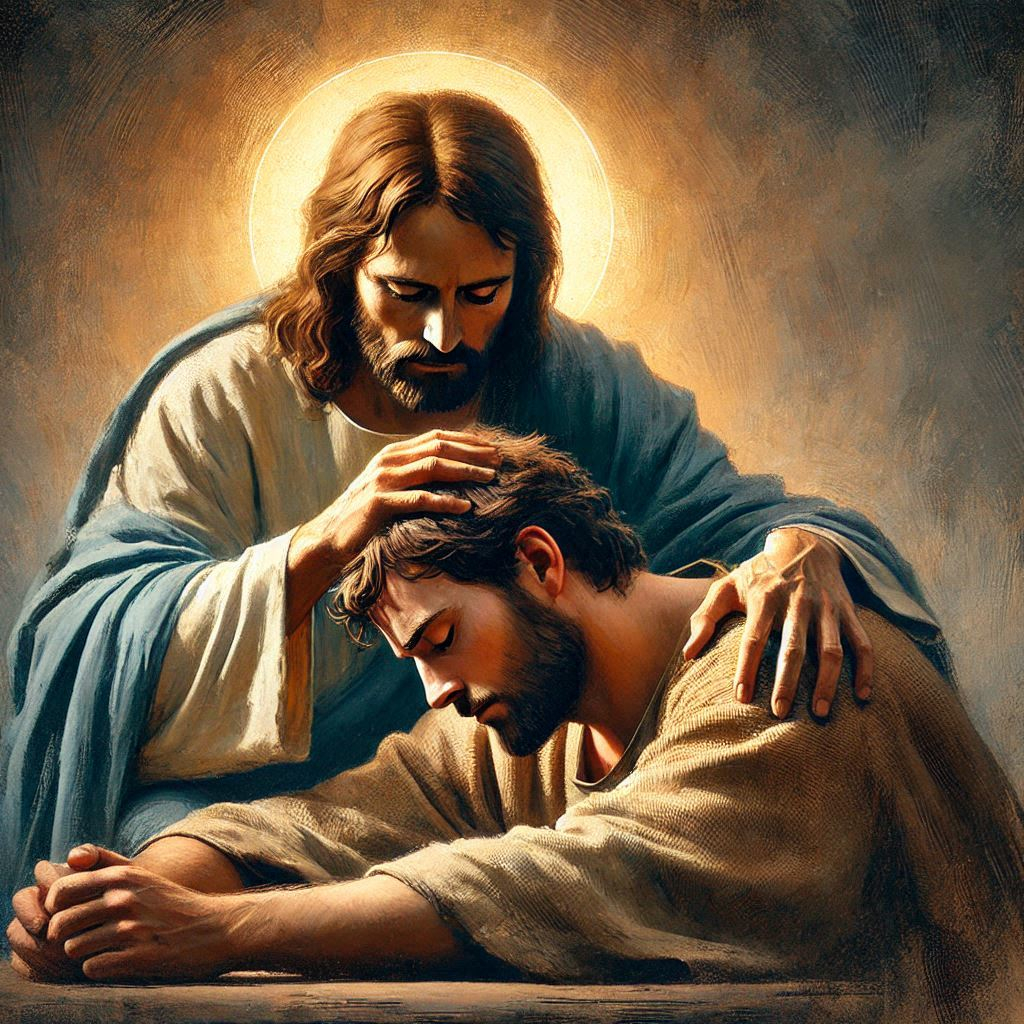
Last week, I had the privilege of working a baptismal session in the Temple with our wonderful Spanish branch-- most of them recent converts doing this work for the first time. They were untrained and nervous, so there were many do-overs. As I watched these humble brethren intently struggle through the ordinance, I thought back to my own first time doing baptisms for the dead, and how I managed to fumble things in my own unique way. When I was twelve, only endowed Melchizedek Priesthood holders could perform the ordinances, so the responsibility for all the baptisms often fell on a single young men's leader for the entire session. I could see this good brother's arms growing tired, so when it was my turn to be baptized, I tried to lighten his load by leaning myself into and out of the water. I guess I overdid it. After just two names, he laughed and said, "Matthew, you're trying to baptize yourself; that's not how this works. Just let go a bit and let me do the work. I've got you." I didn't know how important those words would become to me later in life.

Why our resolutions fail
I'm writing this post from the cafe of the YMCA (I come here regularly, but I'm no gym rat-- I drop the kids at the daycare while I work). Right now, this place is absolutely packed! I shouldn't be surprised-- it always fills up during the first month of the year as people try to meet their resolution to lose weight and get in shape. I looked it up just now-- the word "resolution" only occurs once in the entire Book of Mormon. Alma 47 tells of a group of people "fixed in their minds with a determined resolution" to break out of a rut and make some wonderful changes in their way of living. How did their resolution go? They started very strong. Then old temptations started to wear them down a bit. Then they started to cheat and compromise. And within a few weeks, they were right back where they started. Sound familiar?

Popsicle sticks and the Atonement of Jesus Christ
Thirty minutes had passed and most of the missionaries were back in the chapel. But not my companion. Forty minutes and a few more stragglers came in. But not my companion. Fifty minutes and the APs started us singing hymns and bearing testimonies to pass the time, but my mission president and my companion were still absent. I started getting nervous. Finally, after a full hour had passed, my companion came back into the chapel alone, and our mission president hurried to the stand to continue the meeting. I didn't ask my companion what happened; when we wrapped up the day, he told me himself. And what he said changed my understanding of the Atonement of Jesus Christ forever.