
When repentance doesn't fix everything
Almost all my recent posts have dealt with the war chapters in Alma. The Nephites, led under Moroni, fought the Lamanites and learned lots of lessons along the way. So many years of terrible war, including 2 civil wars within the Nephites themselves. Eventually, Moroni and his armies won the day and the Nephites finally had peace. But sadly, the break was short; it was only a few years after Moroni passed away that the Nephites fell back into serious transgression and were ripe for destruction. Right on cue, like the itsy bitsy spider, down came the Lamanites to wipe the Nephites out.

For the fathers who aren't there
We all know the story of the stripling warriors. "They had been taught by their mothers, that if they did not doubt, God would deliver them." They bore their testimony to the prophet Helaman that "we do not doubt our mothers knew it." The story of those 2000 young men is a powerful testimony of the impact of righteous women on the rising generation. You almost definitely heard the story recounted in Sacrament meeting just one month ago on Mother's Day. So what do they have to do with Father's Day? Because of this question: where were the dads? Why do we hear of their amazing, faithful mothers but little mention of their fathers?

Easier to maintain than to fix
When I was a teenager, my household chore was the burdensome task of cleaning the "tile area" of the house. This included the entire kitchen, the dishes, the bar area, the dining room, the table, and setting/clearing meals. The rule was that my chores were to be completed to perfection every morning before I left for seminary and school. My mother would inspect them in the morning when she woke up, and if it was lacking, I would be pulled out of school unexcused to complete the job. The repercussions of a job not done terrified me. So I stayed awake cleaning my assigned areas each weeknight for an hour or two (depending on how much mess had accumulated). Every night, I would be surprised and annoyed to see how quickly our family of six (including four boys) turned my spotless assignment into a nightmare of a mess. But by the time I went to bed each night that year, the entirety of my assignment was ready for a showroom. I learned several lessons from this assignment:

Marvel, and Marvel Not
We should marvel. But it has to be the right kind of marveling

Just men and women are just men and women
WARNING: SCRIPTURES TAKEN OUT OF CONTEXT AHEAD. Do not attempt at home. One of the obstacles missionaries run into when teaching the Gospel is the fact that the general population is largely unfamiliar with the old "King's English." Since most of our Standard Works are written in the English of the King James Bible, this becomes a problem when trying to teach the Gospel as missionaries. Investigators often read "ye" and "yea" as just alternate spellings of "yeah" or "yay." "Hath," "wist," "wot," and "listeth" are stumbling blocks when trying to use the Book of Mormon or the Bible to teach important doctrines. But sometimes that stumbling block can help us see another meaning to the Scriptures, too.

It had an end
Today is Mother's Day. But instead of talking about the stripling warriors, Abish, or Sariah today, I want to talk about a few words I found in Helaman 1. This year, my wife, my sweetheart, and the mother of my son is spending Mother's Day out of the country on a dream trip across Europe with her sister and some extended family members. She is having a great time, and loving the enchanting sights and sounds of the countries she is visiting.

When you have every advantage
These are a few of my thoughts as I read the story of Lehonti's people in Alma 47. Historical background After failing to be elected king over the Nephites, the evil Amalickiah deserted over to the Lamanites. He immediately gained a position of prominence and trust at the Lamanite king's side, then quickly convinced the king that they should all go to war with the Nephites. Fortunately, some of the Lamanites were smart enough to remember back perhaps 2 years ago to the last time they tried to invade the Nephites under the command of a crown-seeking Nephite dissenter (Zerahemnah). In fact, it's possible they were among the Lamanite soldiers who, 4 chapters before, had made a covenant never to come against the Nephites to war again. So, they refused the king's command for war. These soldiers gathered together to fight against king's command to go to war against the Nephites. I want to pause here and make the application to us.

Why we bridle
The other day I read this verse from Alma the Younger to his son Shiblon:Use boldness, but not overbearance; and also see that ye bridle all your passions... -- Alma 38:12I think this is one of the most oft-quoted verses in all the Book of Mormon, usually in a lesson targeted to young men and young women (you know the one I'm talking about). But what stuck out to me this last time through is the rest of the verse:See that ye bridle all your passions, that ye may be filled with love.
Not to trifle with the words
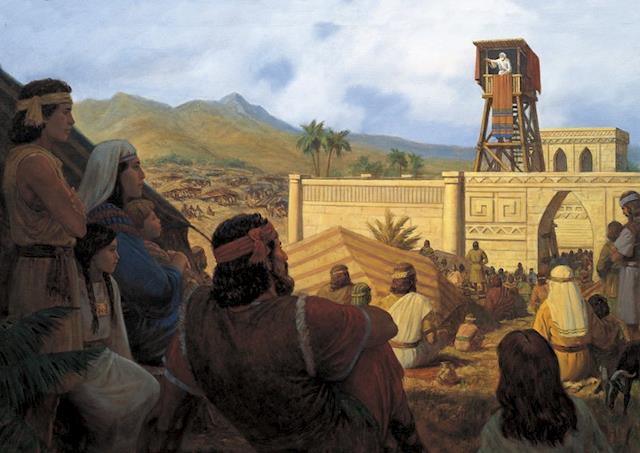
Shortly before his death, the righteous prophet/king Benjamin gathered together all his people to give them the instructions he had received from God. As I read through the account of this Nephite General Conference, I was impressed by the similarities to our own General Conference.

Work changed the Lamanites
My previous post was inspired by Alma 53:5. This one is, too. Specifically this part of the verse:Now Moroni was compelled to cause the Lamanites to labor, because it was easy to guard them while at their labor.To us this may seem like no big deal. After all, in our modern day the Geneva Convention makes clear that this is perfectly fine as long as the labor falls into the classifications set forth in Article 50. But the fact that Moroni mentions it makes it sound like turning your prisoners into workhorses maybe was not the norm in warfare at that time. Furthermore, this concept of daily, taxing work was probably somewhat of a foreign concept to the Lamanites.